
You’re faced with a damp basement and considering your options: French drains or sump pumps. Each method has its own strengths. French drains function on gravity’s terms, redirecting water with minimal fuss, while sump pumps forcefully evacuate water, standing ready for heavy flooding. However, they’re also subject to mechanical failures. Your choice hinges on a multitude of factors, including your property’s specifics and your willingness to gamble on potential maintenance issues. But which one truly offers the best solution for your basement? Let’s examine this in more detail.
Understanding French Drains
The concept of French drains may seem complex at first glance, but we’ll break it down for you. Fundamentally, a French drain is a simple, effective system designed to divert water away from your property. It’s a trench filled with gravel or rock, containing a perforated pipe that redirects surface and groundwater away from an area.
The workings are based on a simple gravity principle. Water is directed into the trench, where it’s collected in the perforated pipe. The water then naturally flows down the pipe, as it’s installed at a slight downward slope. It’s directed towards a safe distance from your property, where it won’t cause any damage.
To guarantee your French drain functions correctly, it’s vital to take into account the trench’s depth and width, the size and type of gravel, and the pipe’s slope. The trench should be deep and wide enough to accommodate the expected water volume.
The gravel used should be coarse enough to allow water to flow freely. The pipe’s slope should be sufficient to enable water to drain effectively without stagnating.
The Basics of Sump Pumps
Diving into the world of sump pumps, you’ll find a device specifically designed to prevent water buildup in your basement. This pump is typically housed in a sump pit, a hole with a gravel base, dug at the lowest part of your basement.
When water flows into this pit, the pump activates and moves the water away from your home to a place where it won’t cause damage, such as a municipal storm drain or a dry well.
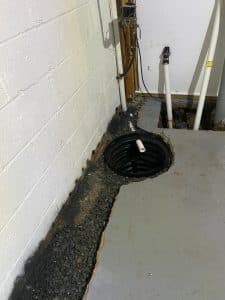
You’ll find two main types of sump pumps: pedestal and submersible. A pedestal pump’s motor is mounted above the sump, where it stays dry and is more easily serviced.
A submersible pump, on the other hand, is fully enclosed within the sump pit and is securer, but it’s also harder to access for maintenance.
The pump’s capacity should be suitable for the amount of water it’ll need to handle. This depends on factors like your home’s location, soil type, and the groundwater level.
A high-capacity pump isn’t necessarily better if your needs are minor. Understanding these basics will help you make an informed decision.
Installation Process Compared
Let’s now turn our attention to the installation processes of both French drains and sump pumps.
You’ll find that each method involves a considerable amount of labor, but the complexity and time required can vary notably.
We’ll analyze these differences in detail, considering factors such as necessary tools, excavation depth, and the skills required for each installation.
French Drains Installation
Installing a French drain requires a good deal of technical know-how and precise execution. You’ll first need to identify the most effective location for your French drain. This typically is the area where water accumulates the most.
Next, you’ll dig a trench. Its depth and width depend on the extent of your water problem. However, it’s essential that the trench slopes away from your house – a minimum of 1% slope is recommended. This slope guarantees that water flows away from your foundation rather than towards it.
Once the trench is dug, you’ll line it with a layer of washed gravel. On top of this, you’ll place a perforated pipe, holes facing down. This pipe is what actively collects the water. You’ll then cover the pipe with more gravel, leaving only a small portion of the pipe visible.
Finally, you’ll cover the gravel with a layer of landscape fabric to prevent soil from clogging the drain and then replace the topsoil.
This process requires accuracy and patience. Mistakes in the installation can lead to ineffective drainage or even damage to your foundation. As a result, it’s often recommended to enlist the help of professionals.
Sump Pumps Installation
In contrast to French drains, setting up a sump pump might seem a bit more complex, but it’s still well within the scope of the DIY capable. Your first task is to identify the lowest point in your basement—that’s where you’ll want to install your sump pump. It’s essential that you pick the right spot because this is where water will naturally flow.
Next, you’ll need to dig a hole for your sump pit. The pit should be deep and wide enough to accommodate your sump pump. Once you’ve dug the pit, you’ll place the pump inside and connect it to a power source. Remember, it’s important to use a GFCI outlet to prevent electrical shocks.
After the pump is in place, you’ll need to run a discharge pipe from the pump to the outside of your home. You’ll want to make sure this pipe slopes downward away from your house to prevent water from flowing back into your basement.
Finally, you’ll cover the sump pit with a lid to keep debris from falling in and clogging the pump. Once everything is set up, you can test your sump pump by pouring a bucket of water into the pit. The pump should turn on automatically and start pumping water out of the pit.
Installing a sump pump does require more work than a French drain, but it can be a more effective solution for severe water problems. Plus, it’s a project you can tackle on your own if you’re handy and have the right tools.
Cost Analysis: French Drains vs. Sump Pumps
When evaluating a home water management solution, you’ll find both French drains and sump pumps come with their own cost implications. It’s vital to weigh these costs against their relative effectiveness in your specific situation.
Typically, installing a French drain costs between $2,800 and $6,500, depending on the complexity of the project and your geographic location. This investment covers excavation, drain installation, gravel, and labor.
However, keep in mind that exterior French drains can be notably more expensive due to the additional excavation and landscaping required.
On the other hand, a sump pump installation generally ranges from $1,000 to $2,000. This cost covers the pump itself, professional installation, and the creation of a pit for the pump.
However, you’ll need to evaluate the cost of electricity to run the pump, which can add up over time.
While the initial cost of a sump pump is typically less than a French drain, the ongoing operational costs may make it more expensive in the long run.
Hence, when performing cost analysis, it’s important to take into account both initial and long-term costs. Ultimately, the choice between a French drain and a sump pump should reflect your home’s specific needs and your budget.
Maintenance Requirements
Let’s shift our focus to the maintenance requirements of both French drains and sump pumps.
You’ll need to understand the regular upkeep necessary for a French drain and the servicing requirements of a sump pump.
It’s important to factor in these ongoing costs and efforts when making your decision.
French Drain Upkeep
Maintaining your French drain is critical to guarantee its effectiveness and longevity. Regular upkeep involves clearing debris, inspecting for damage, and verifying proper water flow. It’s essential that you keep the drain’s surface free from leaves, twigs, and other detritus that could clog the system. You’ll need to periodically rake or vacuum the area to prevent blockages.
Next, consider the drain’s structure. Look for signs of damage or wear, such as cracks or sagging sections. If you spot any issues, they need immediate attention to prevent more serious problems. It’s also wise to check the drain after heavy rainfall or snowmelt to verify it’s operating correctly. Water should flow freely through the system, away from your foundation.
Additionally, you might need to refresh the gravel surrounding the drain pipe. Over time, soil can mix with the gravel, reducing its effectiveness at facilitating drainage. If you notice water pooling or slow drainage, it’s a sign that the gravel bed might need replenishing.
Lastly, don’t forget about the exit point of your French drain. Confirm it’s not obstructed, allowing water to exit smoothly.
Sump Pump Servicing
Just as proactive care is necessary for the longevity and effectiveness of French drains, the same applies to sump pumps.
You’ll need to guarantee regular servicing to keep your sump pump in peak condition.
First, you should visually inspect the pump at least every three months. Look for any signs of wear and tear or damage to the pump or its components. Check the power cord, the float switch, and the discharge pipe.
Next, every year, you need to conduct a more detailed inspection and service. This includes cleaning the sump pit, testing the pump by pouring water into the pit, and examining the check valve to confirm it’s functioning correctly.
If you’ve got a backup battery, it’s essential to replace it every two to three years. You don’t want to find out the hard way that it’s not working during a power outage.
Lastly, every five years, consider completely replacing your pump. This might seem like an unnecessary expense, but it’s a proactive measure that can prevent costly water damage in the future.
Evaluating Effectiveness and Efficiency
Evaluating the effectiveness and efficiency of French drains and sump pumps is a critical step in deciding which system is right for your needs.
You’ll want to contemplate various factors such as your property’s layout, the water table level, and the severity of your water intrusion issues.
Effectiveness, in this regard, refers to how well the system can prevent or mitigate water damage. A French drain’s effectiveness is largely dependent on the slope of your property and the drain’s placement.
It’s designed to divert water away from your home, but it’s not as effective when the water table is high or if there’s severe flooding.
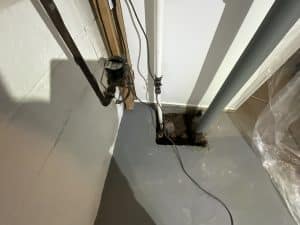
On the other hand, a sump pump is highly effective in actively removing water from your basement or crawl space, even in extreme conditions.
Efficiency, by comparison, is about the system’s operation and maintenance costs. French drains are generally more efficient with respect to energy use as they rely on gravity.
However, they may require more maintenance than sump pumps, which can add to the overall cost.
Sump pumps, while using more energy, typically require less maintenance, making them potentially more cost-efficient in the long run.
Case Studies: Real-World Comparisons
Diving into real-world comparisons, it’s vital to examine case studies of French drains and sump pumps in action.
For instance, reflect on a 1970s home in the Midwest. The homeowner installed a sump pump to combat the heavy rainfall in his area. Despite regular maintenance, the pump’s motor burnt out during an extreme rain event, causing basement flooding. This underlines the risk of relying solely on sump pumps, which can fail due to mechanical issues.
In contrast, a French drain installation in a New England home showed more consistent results. Despite the heavy snowmelt each spring, the homeowner reported no water intrusion in the basement for over a decade. This highlights the French drain’s ability to handle large volumes of water over time without mechanical failure.
However, it’s important to take into account that the French drain’s success may also be due to the property’s favorable grading and soil type. Additionally, installation costs were markedly higher than the sump pump.
So, is a French drain or a sump pump the best waterproofing solution for your property? Well, it comes down to your specific circumstances. Consider your location, soil type, and water table levels. Crunch the numbers on installation and maintenance costs. Don’t forget to factor in energy efficiency and potential mechanical failures. Ultimately, a detailed and thorough analysis will guide you to the right choice. After all, isn’t peace of mind worth a little homework?

For more than a decade, we have been the go-to waterproofing and related services provider for homeowners across New Jersey. Our reputation has been built on a foundation of delivering exceptional workmanship and top-notch customer service to each and every one of our valued clients.
We truly understand the significance of your home to you and your family, as well as the importance of the services we offer in safeguarding your home. That’s why we take our responsibilities seriously and never compromise on the quality of our work. Our commitment to your satisfaction is unwavering, and we go above and beyond to ensure that you are completely content with every aspect of the job we perform.
When it comes to protecting your home, trust is of utmost importance. At our professional New Jersey Waterproofing Company, we prioritize the well-being of your basement and ensure it remains shielded from any harmful moisture damage, regardless of the job’s size. Whether you require waterproofing, mold remediation, or even foundational or structural repairs, we are always ready and eager to take on any challenge.
Our singular focus is your happiness, and we leave no stone unturned in achieving it. If you are searching for a trustworthy New Jersey waterproofing company to safeguard your home, look no further. Contact us today and experience firsthand what sets us apart from the competition. Your home’s protection is our major priority, and we are here to serve you with dedication and expertise.